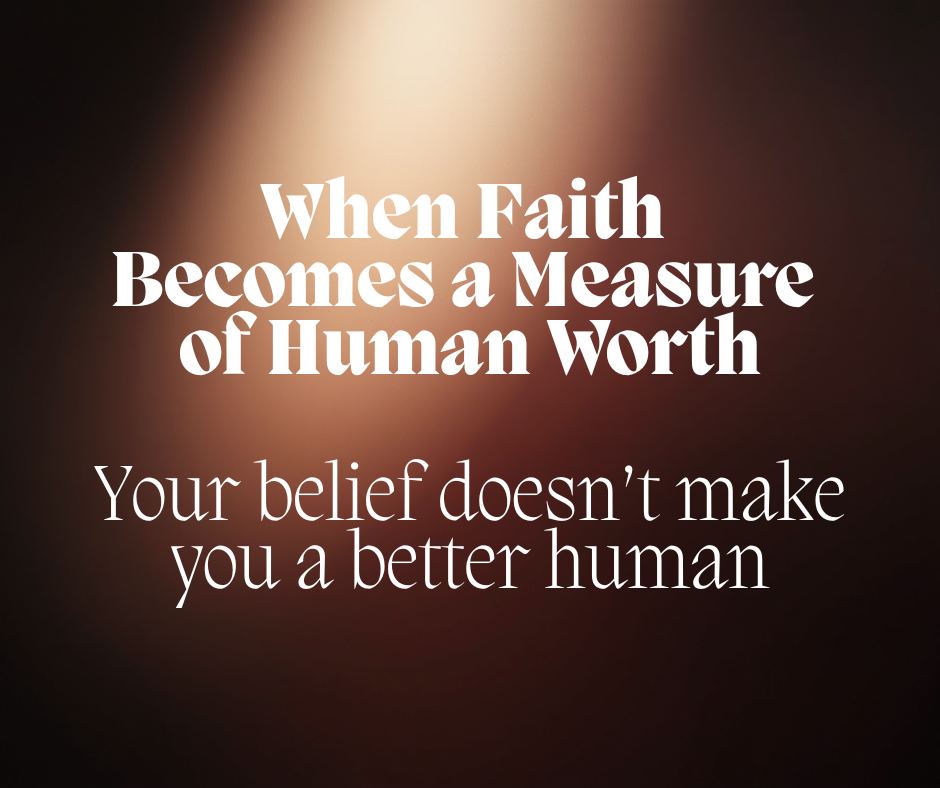

What happens when a child is taught a belief system before they have the developmental capacity to question, contextualize, or understand it, and that belief system includes a framework of “us who are good” versus “them who are sinful.
I watched a video the other morning that made my stomach turn. It was a father and his 6 year old daughter in the car. Here’s how it went:
Dad said: “I love seeing you preach. Preach to the people. Tell them the word if they are listening and they’re struggling with something.”
And this precious little girl responded: “Ask for God’s wisdom. We are his sheep. He’s our shepherd. What kind of human are you if you don’t even listen to Him?”
Dad asked: “Why do people not listen?
Daughter: “They have sin in their heart.”
Dad: “How do they get that sin out?”
Daughter: “By worshiping.”
And there it was. A young child… ONLY 6 years old… has already learned to divide humanity into categories.
Those who listen to God… And those who don’t.
Those who have God in their hearts…. And those who have sin.
Those who worship correctly… And those who apparently aren’t the right kind of human.
What struck me wasn’t that she believed in God. Children believing in God isn’t the problem. Faith isn’t even the problem.
The problem is what happens when a child is taught that their beliefs determine the moral value of everyone else.
Because she wasn’t simply saying, “This is what I believe.”
She was saying, “What kind of human are you… if you don’t believe what I believe?”
That is a very different message!
And it got me thinking about how much of what we call morality is actually conditioning.
Children don’t distinguish belief from truth the way adults do.
When a trusted parent says, “This is God’s truth,” a young child doesn’t have the cognitive tools to respond, “Interesting. I’ll investigate the historical, philosophical, theological, and sociological implications of that claim.” They absorb it as reality… And children are quite literal.
Children don’t have the developmental capacity to independently examine theology, history, philosophy, religious institutions, cultural context, or competing belief systems. They trust the adults they love.
So when we tell a child, “This is God’s truth”, they don’t hear it as one belief among billions of humans throughout history. They hear: This is reality.
And when we add, “People who don’t believe this have sin in their hearts,” they don’t hear nuance.
They hear: Those people are different from us.
And perhaps even: Those people are not as good as us.
I’ve experienced this personally. I’ve literally had children tell me I’m going to hell because I don’t go to church. And what’s fascinating is that those same children were confused by the idea… Because they know me!
They know I am kind.
They know I care about people.
They know I help animals.
They know I show up for my community.
So they were left with a contradiction: “If she’s a good person, why won’t she go to church?”
What happens when the person in front of you doesn’t fit the belief system you’ve been given?
Do you reconsider the belief? Or do you decide the person must be wrong?
That’s where religious conditioning becomes very dangerous.
Not because every religious person is dangerous or because faith is inherently bad. And certainly not because every teaching in the Bible is harmful.
In fact, there are beautiful teachings within Christianity about compassion, generosity, forgiveness, humility, service, caring for the vulnerable, and loving your neighbor.
But organized religion is a human institution. And humans have a remarkable talent for taking something sacred and turning it into a system of power, hierarchy, control, and certainty.
When questioning the institution becomes synonymous with questioning God, critical thinking becomes incredibly difficult.
When questioning scripture becomes a sign of weak faith, curiosity becomes dangerous.
When leaving the church means losing your community, your family, or your identity, love and belonging become conditional.
And when children are taught that their beliefs make them righteous while everyone outside those beliefs is sinful, we aren’t teaching spirituality… We’re teaching hierarchy. We’re teaching judgment. We’re teaching an “us” versus “them” mentality.
And we’ve seen what happens when humans become convinced that their group is morally superior to another group.
I’m not naive, religion isn’t the only place this happens.
Humans do it with politics. Race. Nationality. Class. Education. Culture. Even the way we parent.
We create categories. We decide who is “right.” Who is “good.” Who is “saved.” Who is “educated.” Who is “worthy.” Who belongs. And then we find ways to justify treating everyone outside our category differently.
I would encourage you to look inward and ask: “What does my belief make me believe about other human beings?”
Does it make me more compassionate? More curious? More humble? More willing to acknowledge that I might not have all the answers?
Does it make me love people who don’t believe what I believe?
Does it allow my children to ask questions?
Does it allow someone else to walk a completely different spiritual path without needing to be corrected, saved, or condemned?
Or does it teach: We’re right. They’re wrong. We’re saved. They’re damned. We’re good. They’re sinful.
Because there is a massive difference between: “This is what I believe.”
And “Because I believe this, I am better than you.”
I don’t care what you believe. Believe deeply. Pray. Worship. Go to church. Don’t go to church. Read the Bible. Question the Bible. Find God in a sanctuary, in nature, in meditation, in music, in community, or in your own heart. Or don’t believe in God at all.
You are allowed to walk your own path. Just don’t teach people, especially children, that your path makes you more worthy than someone else.
Instead of learning that someone’s worth is determined by whether they believe the “right” things. What if they learn that people can disagree deeply and still treat each other with dignity.
Instead of inheriting our fear of people who are different. What if we teach them to be curious.
And perhaps most importantly, help them understand that being a good human isn’t something you earn by belonging to the “right group”. It’s something you practice.
In how you treat people.
In how you respond when someone is hurting.
In whether you can admit when you’re wrong.
In whether you use your power to control or to care.
In whether you can hold your beliefs without needing to diminish someone else’s.
That little girl may grow into an incredibly compassionate woman… Or she may grow up believing that people outside her faith are inferior, immoral, damned, or in need of saving.
And the difference isn’t whether she believes in God. It’s what she was taught her belief means about everyone else.
The most spiritual thing we can teach a child is how to love people without needing them to become like us first.
❤️ Terica
